Showing posts with label The Print Shop. Show all posts

Tuesday, 24 December 2013

Merry Christmas!


It's our last day!

It's been a blast, but at 4pm today we'll be closing our doors forever!

We'd like to thank all of the printmakers and guest artists who were involved in making our vision for unique printing space and celebration of Bristol printmakers a reality, and all of you who have taken the time to visit us and share your enthusiasm for printing.

It's not too late to drop in today and have a look at some of the extraordinary prints and wares that our printmakers have to offer, so why not pop in and enjoy some festive cheer with us.

Thursday, 19 December 2013

5 reasons why you should visit The Print Shop


5 days to go, and 5 reasons why you should visit The Print Shop in its final week.


Photograph by Made in Britain
1. Because we're not here for much longer!

As a pop-up (or temporary shop), it really is our last week, so if you haven't already been in, now's your chance!  The shop is still brimming with wonderful things by local makers.

Photograph by Dawn Cooper
2. You're in for a unique experience

We've had so much fun leading workshops and showing you how to print through different processes.  At the heart of our ethos is making and hand-printing things yourself, which is why you might be lucky enough to catch one of our printers hand-printing their items in a live shop demonstration - you could even buy them on the same day!


Photograph by Carys Ink
3. You can buy something genuinely different

Fed up with seeing the same things everywhere?  Want to buy something just a little bit different and special for your favourite people?  You've come to the right place!  With over 35 different Bristol makers and exclusively handmade and hand-printed goods, you're not likely to find our one of a kind items anywhere else.  And handmade presents are always appreciated!


Photograph by Love Local
4. It's time to shop local!

I couldn't have put it better myself, Bryony!  Bristol is brilliant, and it's becoming more and more important to support local makers and enrich our local art scene and economy.  So why not pick up something that has been handmade in Bristol by independent artists?  A heartfelt local purchase can go a long way.  What's more, you can meet the makers directly in the shop, and visit our fantastic neighbours, Paper, Scissors Stone and Made in Britain in the same square!

Photograph by Sophie Rae
5. Because we love having you in the shop.

A busy shop makes for happy printmakers.  It's been a joy meeting you all, and enjoying engaging conversations about your printmaking, and answering your questions about our artists and methods.  Come in and bring the festive cheer, and we'll make you feel very welcome!

Thursday, 5 December 2013

Late night shopping at The Print Shop


Not got time to shop during the day?

We're staying open later in the run up to Christmas, to give you time to browse and find the perfect gift.  So come in from the cold, and take a look at our extensive selection of lovingly hand-made, local goods.

We're open from 9:30 until 8 on:

Thursday 5 December
Saturday 7 December
Thursday 12 December
Friday 13 December
Saturday 14 December
Thursday 19 December
Friday 20 December
Friday 21 December
Monday 23 December

We're also open until 4:30pm on Christmas Eve (our last day!), for those last minute but all important purchases!

Sunday, 1 December 2013

New for Volume 4: Chalkboards


Screen-printer Carys Ink has been busy dreaming up all sorts of innovative, 'upcycled' items for this round of The Print Shop.  These super chalkboards, made from reclaimed scaffolding planks from the Bristol Wood Project, have been hand screen-printed, finished and assembled with a cord ready for you to hang it up and record important memos or friendly greetings!

The boards are available in two bold designs, pictured above, which we're sure will be incredibly popular, so drop in and see them for yourself.

1Sandwich board character £20  | 2. Little bird £16

Friday, 1 November 2013

Peter Williams - Terrestrial Locomotion - The Final Guest artist at The Print Shop.


Peter Williams, based in Cardiff is the Co-founder and studio director for The Print Market Project.

On display from the 6th November until the 29th November

Pete will be transforming the entire feature wall at The Print Shop into one giant woodcut as he displays a huge block from his epic body of work Terrestrial Locomotion.

As the title suggests the work began its journey as a movement across country. Carrying a tiny sketchbook and a pencil Pete would begin by setting his running watch to zero, choosing a direction and then running in that direction until he couldn’t run any longer. Whatever appeared in front of him at this point would then be the subject of his initial drawing.

The Wood block we are lucky enough to be showing at The Print Shop in Bristol depicts what is left of the LLywernog Silver mine, in the title is also the Distance, 6.38m, the step count 8594 steps and the time 54minutes 18 seconds. This numerical figure serves to the picture a kind of map reference to where the subject stands, from the point in which the artist began his run. The circular shape signifies to Pete a kind of medallion for each run in the series of works.

About the work he says that ‘so many artists spend forever deciding what to create a piece of work about and at the end of the day it could as well be anything’. This method of letting chance and stamina find the subject presents a new way of looking at the artist’s context for which they base their work.  Routed in landscape the work has a physical context not only in how the subject was chosen but also it’s method.

From a drawing about 3inches square Pete reworks the image onto a block 8ft square and then uses chisels, wire brushes, power saws and gouges to expressively recreate the image into marine ply exploiting the directions in the layers of grain and the physicality of the entire process.

It’s great to have this opportunity to show a monumental piece, where the block itself is the art and one which reflects the very essence of print, the transferal of an image from one surface to another.

LLywernog Sliver Mine
6.38m 8594s 54.18
Woodcut Block Black ink on Ply
8ft x 8ft 
2012


For More information about this work there’s a great video interview with Pete at the following link .


Written By JJ Lynch. 

Sunday, 27 October 2013


The Print Shop has a range of workshops on offer this autumn to keep you inspired and creative as the cold weather and long nights draw in.  Refresh your printmaking and craft skills, or learn something new.  We explain some of the print terminology to give you an idea of what's currently on offer.


Etching is an intaglio technique, in which a drawing is created on a sheet of metal (usually copper, zinc or steel) coated with a thin acid resistant layer, with a sharp tool.  The plate is then immersed in a bath of acid which 'bites' or etches away the metal in the areas exposed by the drawing.

Once the design has been etched to a sufficient depth, the acid resistant layer is cleaned off, and ink is rubbed into the lines of the design, before being wiped clean.  A sheet of dampened paper is placed over the plate, which is then fed through a printing press to apply pressure.  This causes the ink to be pulled out of the incised lines and onto the paper, creating the platemark.

Take a look at Gilly Thompson and Liz Bath's Introduction to Etching workshop, taking place on Friday 1 November.

Monoprinting can take many forms, but in basic terms, is a single impression of an image which can only be printed once. It can be made in a number of ways, such as using a metal etching plate, a litho stone, a wooden block, or using paint or collage. 

Sophie Rae, one of our featured printmakers, creates mono prints by sketching, hand cutting paper stencils, and using a roller to mix her vibrant oil-based inks, before applying the inked stencils to her images, and creating lots of depth and layers with graduating tones.

Sophie will be teaching her individual monoprinting technique in her workshop on Wednesday 30 October.  Click here for more details.

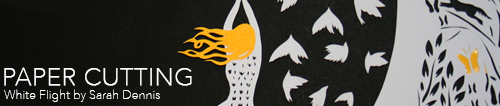
Paper cutting is the art of cutting paper designs (using scalpels and other cutting tools), but can be broadly applied to a number of different applications and styles.  It has evolved uniquely all over the world to adapt to different cultures.

Sarah Dennis, who has joined Volume 3 of The Print Shop to teach others the way of her craft, creates designs inspired by Chinese paper cutting, nature and her childhood.  Her work combines traditional collage with contemporary techniques to create a bold unique and stylised imagery that's bursting with charm.

You can find out more details about her workshop on Thursday 31 October by clicking here.


Wednesday, 23 October 2013

Meet the Printmaker - Anna Harley


The latest of our artist interviews... we were delighted to catch up with Anna Harley. Amongst other things, Anna gives us an insight into her ancestry, influences and love of print...

Please can you introduce yourself and tell us a little about your work…What sort of prints do you make?
I completed a Masters Degree in Printmaking at UWE about five years ago and have been building up a body of work ever since, predominantly screenprints. While the work I make is rooted within the Landscape tradition, the fabric textures in my prints are an echo of my Scandinavian Arts and Crafts background and nomadic childhood. I now live with my family at the foothills of the Mendips, just South of Bristol and divide my time between my studio at home and Spike Print Studio in Bristol. I sell my work through galleries in London, Cardiff and Bristol and also have recently exhibited in London at The Royal Academy Summer Exhibition, Bite: Artists making Prints and Battersea Affordable Arts Fair.

Catkins ( 76cm x 56cm)

Are you solely a printmaker or do you work in any other creative fields?
I now almost exclusively produce screenprints, though I have done a lot of painting in the past, mainly in oils and acrylic. I make a lot of things for my home – ranging from home made curtains and upholstery to the hand printed ceramic tiles that line my shower room! Working as a part time mathematics teacher ensures that there is a regular pay-check coming in and both mathematics and teaching are very creative processes.

What is your earliest recollection of making a print and what made you to want to do more?
I owe my preference for print to my Swedish lineage – my Great grandfather’s sister, Maja Fjaestad, was a well known artist in Southern Sweden. Maja’s paintings and prints decorated the walls of the houses of my relatives and I now even have a few of my own. I grew up surrounded by her work and that of the other Rackstad Artists; equivalent to the Bloomsbury group in England of the same time. The Rackstad colony and grounds, near Lake Racken in Sweden, are now preserved as a museum and art gallery. During an HNC course, I began to make very large scale (150cm x 100cm) woodcut prints. As a result of the large amount of cutting away necessary, I developed trigger finger, a RSI, and looked for another less damaging and quicker print method to use. Screenprint proved to be a flexible alternative print medium that had the added benefit of enabling me to incorporate digital imagery in my work. In a hangover from the relief print production, I still often create stencil cut outs from black card for screenprint exposure and use wood like textures as background to the silhouette imagery: I like the feel of a hand cut line and wood grain effect of chiffon moirĂ©.

Mini Print - Gold Leaf 

What inspires you and are there any themes or ideas that often run through your work? Inspirations for my work include; how it feels to be outside, tree silhouettes, passing seasons, the sky and how it changes from sunrise to evening, the weather..... Like a Jackdaw, I love things that sparkle and twinkle. I often use metallic pigments and, in a move that fully embraced my inner kitsch, I have recently made a snow print using white glitter.

Could you give us an insight into how and where you work?
I constantly collect material and ideas for new prints while gardening, or out walking in the countryside around where I live, in the foothills of the Mendips. I am lucky to have a North facing studio set up at home, where I draw and prepare artwork for printing. Once everything is ready, I make my screenprints at Spike Print Studio, in Bristol, where I have been a member for the last five years. Thanks to Spike Print Studio’s 24 hour access, I have been known to print through the night!...but the best time of day for me is early in the morning. I have a routine – apron on means it is time to work.

Mini Print - Sunrise

Printmaking is made up of lots of different processes, which aspect do you enjoy the most?
The screenprinting process suits my practice, because it allows me to build images in fine layers of ink, printing layer upon layer until I am happy with the final print. I use a combination of drawing, digital photography and objects directly exposed on the screen, to create these individual layers. I enjoy the tension this creates in my images – is the print based on a drawing or photograph? Is it attached to fabric, pencil marks or ink? While engaged in the creative process, I try to stay open minded about how the finished print will look, to allow the print to make itself – print is an extremely process led way of making art and allowing the unexpected to happen and taking advantage of these happy accidents allows the work to stay fresh and exciting. I love the drama of proofing a print; when suddenly everything comes together with the final layer of ink – and the print starts to sing. Once I am happy with the initial artists proof, I will then screenprint an additional number of limited edition prints, each matched against the artist proof, which I sign and edition (1/25, 2/25 etc). Because prints are produced in multiples, high quality prints are much more affordable than other forms of original art. I believe that original art belongs in people’s homes every bit as much as it belongs in public galleries and communal spaces, and with this in mind, I have recently made a series of mini-prints - small landscapes printed in editions of 80, with intention of making artwork that is affordable for all. These will be on sale in the shop during July and August.

Do you have a favorite tool or something you find invaluable when printing?
For the last few years I have almost exclusively printed up to the deckle edge of the paper – I think this is a more contemporary approach to print. Historically a paper margin of around six inches was left around the edge of the print and used to attach the print behind a mount ready to frame - all my work is now ‘float mounted’ so the print appears to float in its frame – celebrating, rather than hiding the print and the paper. The longer I spend as a screen-printer, the fussier I become about my materials. Where I was once perfectly happy with standard acrylic printing inks, I am now only really happy with the expensive higher quality pigment inks available from Lascaux..... I am also a real paper nerd – and love the quality of specialist, acid free, 100% cotton papers like the French artisan made, ‘Arches 88’ – expensive to buy, but worth every penny because of the print quality and archival features.

Starry Night

Can you share a little printing trick or secret with us?
Don’t work in isolation - Community is really important. The best thing I ever did was to become a member of Spike Print Studio, this gave me a base to work from and a readymade artistic community of fellow print makers, to spur me on, bounce new ideas around and help with advice and guidance when I come up against problems.

How would you like to develop your printmaking skills in the future?
Where to start? I make sure I enroll on at least one new course a year and I spend time each week talking to other members at Spike Print Studio about what they are making, in order to keep my work fresh and continually evolving. If I could introduce a few more days to each week, I would experiment across more print mediums. In the near future, I would like to mix embossing, laser and chine collĂ© with screenprint. Anything that involves breaking a few rules – in spite of my Scandinavian upbringing, I am secretly quite subversive…

Which printed publication do you most look forward to thumbing through?
Anything by Deborah Wye

Monochrome or multi-coloured?
Both

A selection of six mini prints, all screen printed
Clockwise from top left: Gold Leaf, Autumn Beech, Sunrise, Starry Night, Sunset, Moon Fruit

Thanks Anna for sharing so much with us, your prints are truly beautiful!

Anna Harley is one of the many talented printmakers contributing to Volume 3 of The Print
Shop, October 2nd - November 3rd... Why not come along and have a look for yourself!


The Print Shop
Unit 6
Quakers Friars
Cabot Circus
Bristol
BS1 3BU

Open Daily
Mon - Sat 10am - 6pm
Sun 11am - 5pm